
Rather than scroll through a static chart trying to find your row, enter any size you already know and get every equivalent instantly. No chart-hunting required.
Why a Calculator Beats a Static Chart
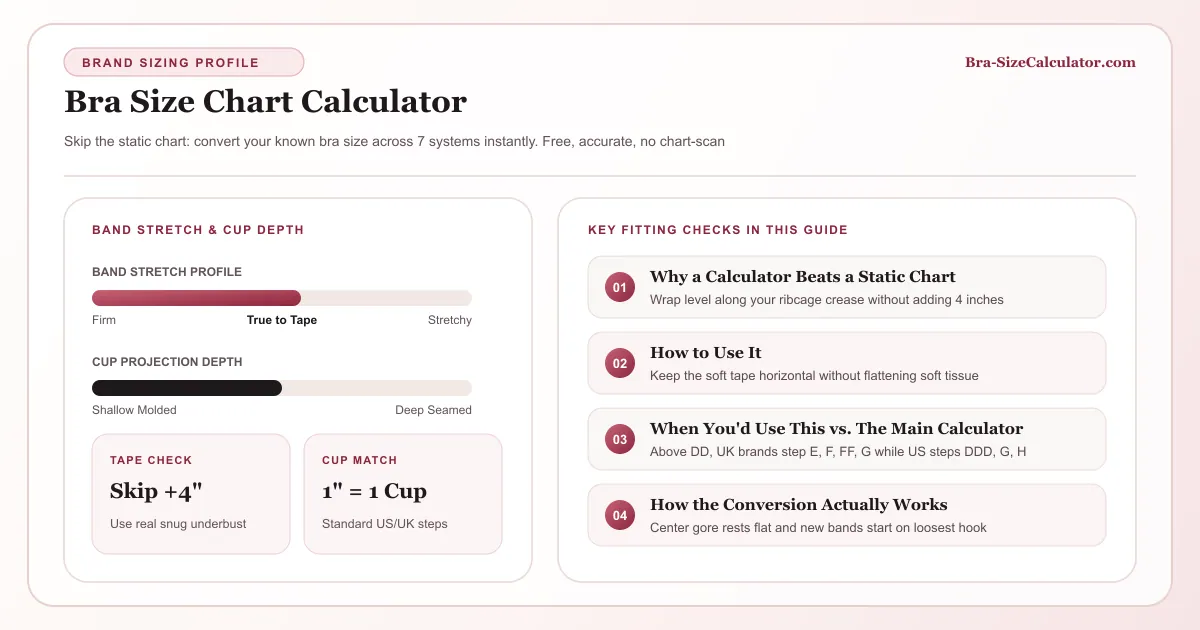
A printed size chart makes you scan rows and columns manually, and it’s easy to misread a row when band and cup labels are printed close together. This tool does the same lookup instantly and accurately from whichever size and system you already know.
How to Use It
Already know your size in one system? Enter the sizing system, band number, and cup letter. You’ll get the equivalent across all seven systems this site supports at once, calculated from the same underlying underbust measurement.
When You’d Use This vs. The Main Calculator
Use the Main Bra Calculator when you’re starting from a tape measure and don’t know your size yet. Use this chart calculator when you already know your size in one system and need it translated into another. Shopping an international retailer, for example, or checking a size against an old bra’s tag.
How the Conversion Actually Works
Behind the scenes, this tool reverse-derives your underbust measurement in centimeters from whichever band number you enter, then recomputes every other system’s band and cup from that same physical number. That’s why the result is consistent no matter which system you start from. US, UK, EU, Italy, Australia, Japan, or Korea all describe the same underlying measurement, just labeled differently.
Common Chart-Reading Mistakes This Avoids
Static charts get misread more often than people realize: rows blur together when band and cup columns sit close, and a lot of printed charts online still use the older “add 4 or 5 inches” band method instead of the modern approach most fitters now recommend. This calculator uses the current method consistently across every system, so you’re not accidentally mixing an outdated US chart with a current UK one.
Why We Show the Full Chart Alongside Your Result
Seeing your size in context next to neighboring sizes makes sister sizing and brand conversion easier to understand at a glance, rather than looking up a single isolated number.
How the Chart Is Actually Built
Every row on the chart traces back to the same two input numbers (your underbust and bust measurement) run through each system’s specific band and cup labeling convention (inches for US/UK/Australia, centimeters with different rounding rules for Europe/Italy/Japan/Korea). Nothing on the chart is independently estimated; it’s all derived from one consistent physical measurement.
Using the Chart for International Shopping
When shopping from a retailer based in a different country, find your row on the chart and use that system’s column directly, rather than trying to convert a label you already know into a different system. Going back to your actual measurement avoids compounding conversion errors.
What the Chart Doesn’t Capture
Like every tool on this site, the chart reflects a standard conversion formula, not any individual brand’s specific cut. Treat every row as a well-informed starting point, and always sanity-check against a specific product’s own size guide when one is available.
Saving Your Result for Future Reference
Since sizing can shift over time, it’s worth writing down your calculated size and today’s date somewhere you’ll remember, so a future re-check has a clear baseline to compare against rather than relying on memory of what felt right before.
Bookmarking this page makes it easy to return whenever you need a quick cross-system reference without re-entering your measurements from memory.
A Practical Habit Worth Building
Bookmarking your result here makes future brand comparisons faster, since you’ll always have your full 7-system breakdown on hand instead of recalculating from scratch each time you shop somewhere new.