
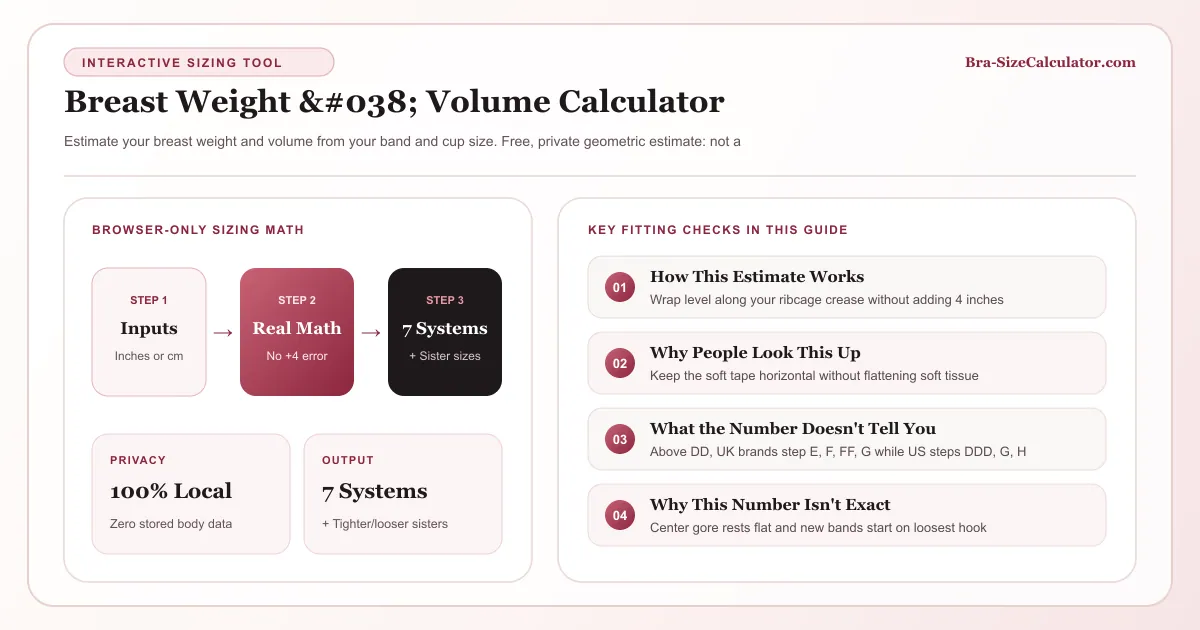
Curious how much your breasts actually weigh? Enter your underbust and bust measurement and get a rough estimate in grams, ounces, and pounds. Free, private, no signup.
How This Estimate Works
There’s no way to weigh breast tissue without surgery, so every online calculator (including this one) works from geometry, not a scale. This tool treats each cup step as adding a roughly hemispherical volume of tissue, then multiplies that volume by an average tissue density of about 0.95 grams per cubic centimeter. Close to the density most published estimates use for a mix of fat and glandular tissue.
The result is a genuine order-of-magnitude estimate, not a clinical measurement. Real density varies from person to person. Someone with denser, less fatty tissue can weigh noticeably more than someone the same cup size with softer, fattier tissue.
Why People Look This Up
The most common reasons: curiosity after a size change, back and shoulder pain questions (heavier breasts pull harder on straps and shoulders), or simply wanting a number to compare against something like “how much does a bag of sugar weigh.”
What the Number Doesn’t Tell You
Weight alone doesn’t predict comfort. Band width, strap width, and how well a bra actually distributes that weight across your ribcage matter more than the raw number. Two people carrying the same estimated weight can have completely different comfort levels depending on their bra’s construction.
Why This Number Isn’t Exact
This estimate uses an average tissue density to convert volume into weight, but actual breast tissue density varies by individual. Some people have a higher proportion of denser glandular tissue, others more fatty tissue, and the two weigh differently at the same volume. Treat the result as a genuinely useful order-of-magnitude estimate, not a clinically precise measurement.
Why Two People at the Same Cup Size Can Get Different Estimates
This estimate is driven by your specific underbust and bust numbers, more than your cup letter. Two people wearing the same labeled cup size can have measurably different actual volumes if their band sizes differ.
How the Math Actually Works
This tool starts with the same underbust-and-bust measurements as the main calculator, then treats each cup step as adding roughly hemispherical volume. The radius grows by about 1.15cm per cup letter, starting from a 4cm base at AA.
That volume gets multiplied by 0.95 grams per cubic centimeter, a commonly used approximation for adipose and glandular tissue density. It’s a geometric model, not a scan, so treat the number as a genuine order-of-magnitude estimate rather than a lab-grade measurement.
Why Two People at the Same Cup Letter Get Different Numbers
Cup letter is relative to band size, so a 32DD and a 40DD hold very different actual volumes even though the letter matches. This calculator uses your specific underbust and bust numbers rather than just the cup letter, which is exactly why it can give two different weight estimates for what looks like “the same size” on a chart.
When This Number Actually Matters
People use this most often when researching reduction or augmentation procedures (to have a starting reference point for conversations with a provider, never a substitute for one), when comparing how weight is distributed across the body for posture or back-pain discussions, or simply out of curiosity about a number that’s genuinely hard to find explained anywhere else.
What This Tool Doesn’t Do
It doesn’t account for individual differences in tissue density (glandular tissue is denser than fat, and the ratio varies a lot person to person), it doesn’t factor in breast shape or distribution, and it can’t replace an actual clinical measurement if you need a precise number for a medical reason. Think of it as a reasonable estimate for general interest, not a diagnostic tool.
Sharing This With a Healthcare Provider
If you’re using this estimate as a talking point for a healthcare conversation, mention clearly that it’s a geometric approximation from measurements, not a clinical measurement. Most providers will find that context useful for setting expectations correctly.