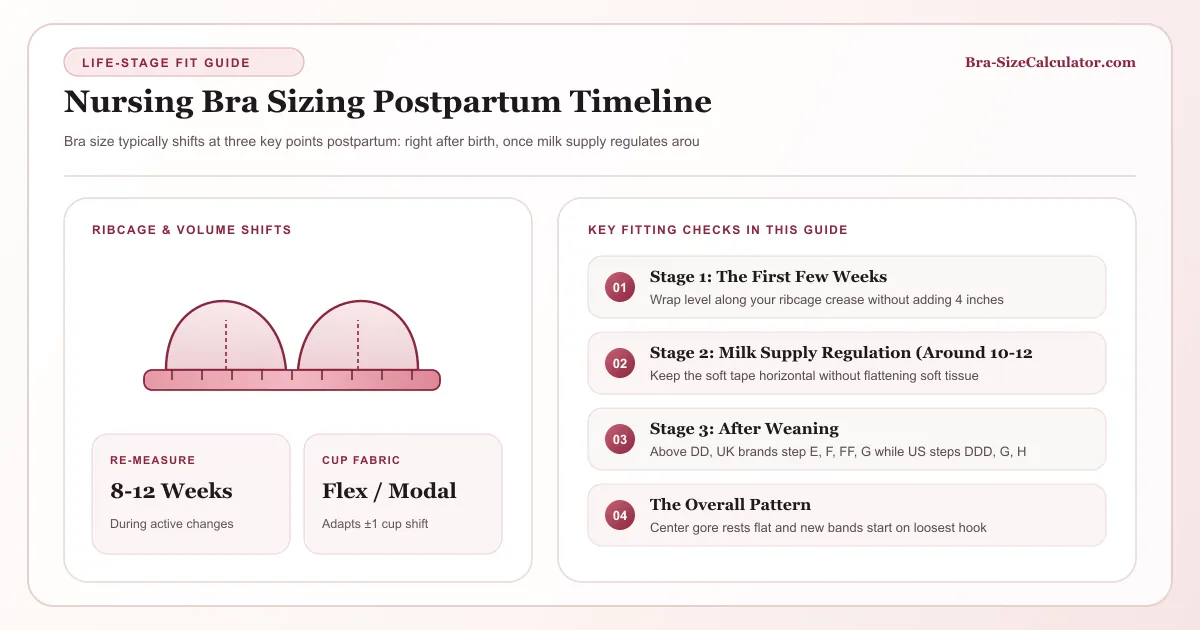
Stage 1: The First Few Weeks
Right after birth, sizing is often still in flux from pregnancy changes plus the first days of milk coming in.
Stretchy, adjustable styles make more sense here than a precisely fitted wired bra.
Stage 2: Milk Supply Regulation (Around 10-12 Weeks)
Once supply settles into a more predictable pattern, size fluctuation throughout the day usually decreases, making this a reasonable point for a more precise measurement.
This is often the point where people invest in their main nursing-bra wardrobe.
Stage 3: After Weaning
- Cup size often decreases as milk production stops.
- Band size may or may not return to its pre-pregnancy measurement. Both are normal.
- A final re-measurement here helps transition back to a regular (non-nursing) wardrobe if desired.
The Overall Pattern
Treating postpartum bra sizing as a multi-stage timeline, rather than a single measurement, saves money and frustration compared to buying a full wardrobe at any one stage.
Stage 2: Once Feeding Establishes (Roughly Weeks 4-10)
As a feeding or pumping rhythm settles in, sizing usually becomes more predictable than the first weeks, though it can still shift meaningfully as supply regulates. This is often a reasonable point for a second, more considered round of nursing-bra shopping.
Stage 3: Post-Regulation (Roughly 3 Months On)
Once supply has regulated, sizing tends to stabilize until weaning begins. This is typically the best window to invest in higher-quality, better-fitted pieces, since the size is more likely to hold for a meaningful stretch of time.
Weeks 1-2: Don’t Overinvest Yet
Initial postpartum fullness and engorgement mean this is the least stable size window of the entire nursing period. A couple of stretchy, adjustable nursing bras or bralettes are usually enough. Buying a full wardrobe now often means rebuying in a month.
Weeks 3-12: The Adjustment Window
This is when most people notice their size shifting as supply establishes and then starts to regulate. Checking fit every few weeks rather than assuming week-6 sizing will hold through week-12 avoids the most common timeline mistake in this stretch.
Month 3 Onward: More Stable, Not Fixed
Once regulation has happened, size swings usually become smaller and less frequent, which is a reasonable point to invest in a more complete, better-fitted nursing wardrobe. It’s still worth a re-measure if feeding patterns change significantly (starting solids, dropping a pumping session, night-weaning).
Around Weaning
Weaning is often the single biggest size shift in the entire nursing timeline, sometimes larger than the initial postpartum change. Waiting until a few weeks after weaning is complete before buying a “final” post-nursing wardrobe avoids sizing for a still-transitioning body.
The First Two Weeks
This is typically the most unpredictable window, with engorgement and milk coming in causing the most dramatic short-term changes. Many experienced nursing parents recommend against buying a full wardrobe of nursing bras until this initial period passes.
One Month and Beyond
By roughly a month in, many people find a size that feels reasonably stable for day-to-day wear, though minor fluctuation around feeds remains normal throughout the nursing period. Full re-measurement around this point tends to be more useful than measuring in the first week.
A Realistic Scenario Worth Knowing
Returning to work and shifting from on-demand nursing to a scheduled pumping routine around 3 months is a common trigger for a secondary size shift beyond the initial postpartum timeline, simply because the feeding pattern itself changed, not because anything went wrong.