Why This Happens
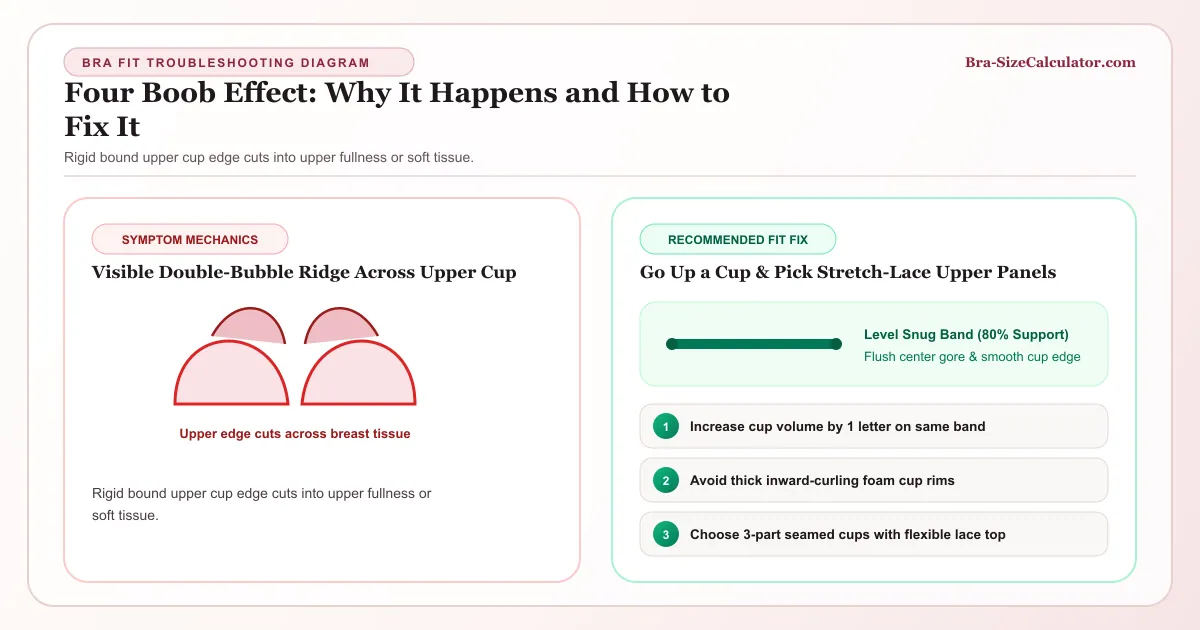
This look gets its nickname because tissue overflowing the top of an undersized cup creates a visible second curve above the bra line.
It’s a cup-size issue, not a shape issue. Any breast shape can show it in the wrong size.
How to Confirm It
- There’s a visible line or dent where the top of the cup cuts across tissue.
- The effect is more visible in fitted tops, less so in loose clothing.
- The band fits fine, pointing to a cup, not band, mismatch.
The Fix
Size up in the cup while keeping the same band. This is almost always enough to resolve it.
A full-coverage cup with a higher top edge will contain tissue more completely than a low-cut style in the same size.
When It Might Be Something Else
If the effect only shows up in one style, it may just be a cut that doesn’t suit your shape rather than a true sizing problem. Try a different cup shape before resizing everything.
The 30-Second Self-Check
Look at the side profile in a mirror. If tissue bulges out both above and below the cup edge (creating the look of a second, smaller shape stacked outside the main one) that’s the classic sign the cup is too small in more than one dimension.
Why This Is a Cup Problem, Not a Band Problem
This effect happens when the cup can’t contain the tissue in either height or width, so it escapes on multiple sides at once rather than just gaping or just spilling at the top. It almost always means the cup itself needs to go up, sometimes combined with a style that has a taller or wider cup profile, rather than only a bigger number.
A too-small band can make this worse by pushing tissue forward into an already-too-small cup, so check the band snugness too. But the cup size is usually the primary fix.
This Isn’t Always About Overall Cup Size
Sometimes the cup volume is close to correct but the cup height (how tall the cup fabric is from bottom to top edge) is too short for your shape. A fuller-coverage or higher-cut cup style in the same labeled size can resolve this without sizing up the letter at all.
When Wire Length Is the Real Culprit
An underwire that’s too short for your tissue can push the top edge of the cup down into your breast rather than around it, creating this exact effect even in an otherwise reasonable size. A longer-wire style is worth trying before assuming you need a bigger cup.
A Quick Self-Check
Look at the profile from the side while wearing a fitted top. If you see a distinct second curve or bulge above the main cup line, that’s the visual signature of a cup pushing tissue up and over its top edge rather than containing it fully.
How to Tell This Apart From Similar Problems
This is closely related to quad-boob but describes a narrower version of the same underlying issue: four-boob-effect specifically refers to the visible double-curve from top overflow, while quad-boob describes a more pronounced version where BOTH top and side overflow happen simultaneously, creating four distinct visible sections rather than two.
What to Try First
A deeper, more structured cup style (rather than a soft or lightly-lined one) at your same size often resolves this before you need to size up. The shape of the cup matters as much as the letter.
A Realistic Example
This shows up often in people wearing an old bra well past its useful life. The cup fabric has lost elasticity and structure over time, so even the original correct size starts producing this overflow pattern purely from bra aging, not a change in the wearer’s body.