Why This Happens
Even without dramatic gaping, a cup that’s slightly too roomy will leave visible empty space that padding or thicker fabric can partly hide but not truly fix.
This is extremely common, since many people size their band too loose and their cup too big to compensate.
How to Confirm It
- You can see the fabric isn’t fully filled, even without an obvious visible gap.
- The band fits snugly, ruling out a band-size cause.
- The empty space is more visible in unpadded or thin-lined styles.
The Fix
Go down one cup size in the same band as the first thing to try.
A lightly padded or molded cup can also help minimize the visual effect of minor remaining empty space, though correcting the size is the more lasting fix.
When It Might Be Something Else
If one side has empty space and the other doesn’t, that’s typically asymmetry. Sizing to the larger side and using a thin pad on the smaller side is usually more comfortable than forcing an in-between size.
The 30-Second Self-Check
Press gently on the cup fabric at the point where it looks emptiest. If there’s a visible air pocket or the fabric collapses inward with no tissue behind it, that spot of the cup is genuinely too big for your shape there.
Localized Empty Space vs. Whole-Cup Gaping
Empty space concentrated at just the top-outer corner of the cup, rather than the whole cup, often points to a shape mismatch (a fuller lower breast paired with a cup built for equal top-and-bottom fullness) rather than a pure size issue. A shallower balconette-style cup, in the same size, is often the more precise fix than sizing down.
Empty space across the entire cup, rather than only one corner, is more likely a straightforward size-too-big issue. Try a sister size down in the cup first.
Empty Space Isn’t Always About Cup Size
Sometimes the cup size is correct but the specific style runs generously in that brand or line. Checking a different style in the same labeled size, before resizing entirely, can save you from chasing the wrong fix. A padded or molded cup can also mask minor gapping that a soft, unlined cup would reveal immediately.
When It’s a Shape Mismatch Instead
If the gap consistently shows at the top outer edge rather than the top center, a style built for a different breast shape (rounder vs. more tapered) may be the real cause rather than the size itself. Trying a plunge or angled-cup style instead of a standard rounded cup sometimes resolves this without any size change at all.
A Quick Self-Check
Check specifically the upper third of the cup after settling the bra into place (a ‘swoop and scoop’ adjustment). If that upper area stays visibly flat or hollow even after adjustment, and the lower cup fits fine, that’s the specific empty-cup-space pattern rather than general oversizing.
How to Tell This Apart From Similar Problems
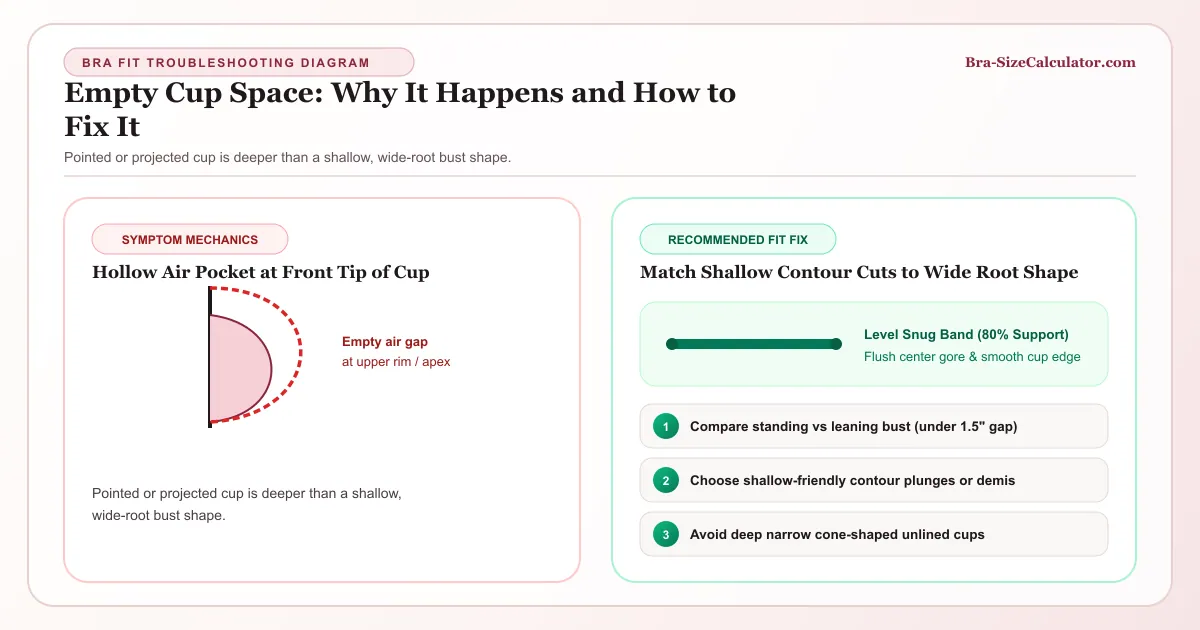
This differs from broader cup-gaping in an important way: general gaping can appear anywhere and usually means the whole cup is oversized, while empty-cup-space specifically persists at the top even when the rest of the cup seems to fit. That pattern often points to a shape/projection mismatch (shallower natural profile than the cup is built for) rather than a pure size problem.
What to Try First
Look for styles described as shallow-cup or designed for a flatter natural profile. These are cut with less front-to-back depth, which fills more naturally without needing extra padding to compensate.
A Realistic Example
This commonly shows up after significant weight loss, where overall tissue volume decreased but did so more from the lower/outer breast than the upper pole specifically. A shallower-profile cup style suited to the new proportions works better than simply sizing down uniformly.