
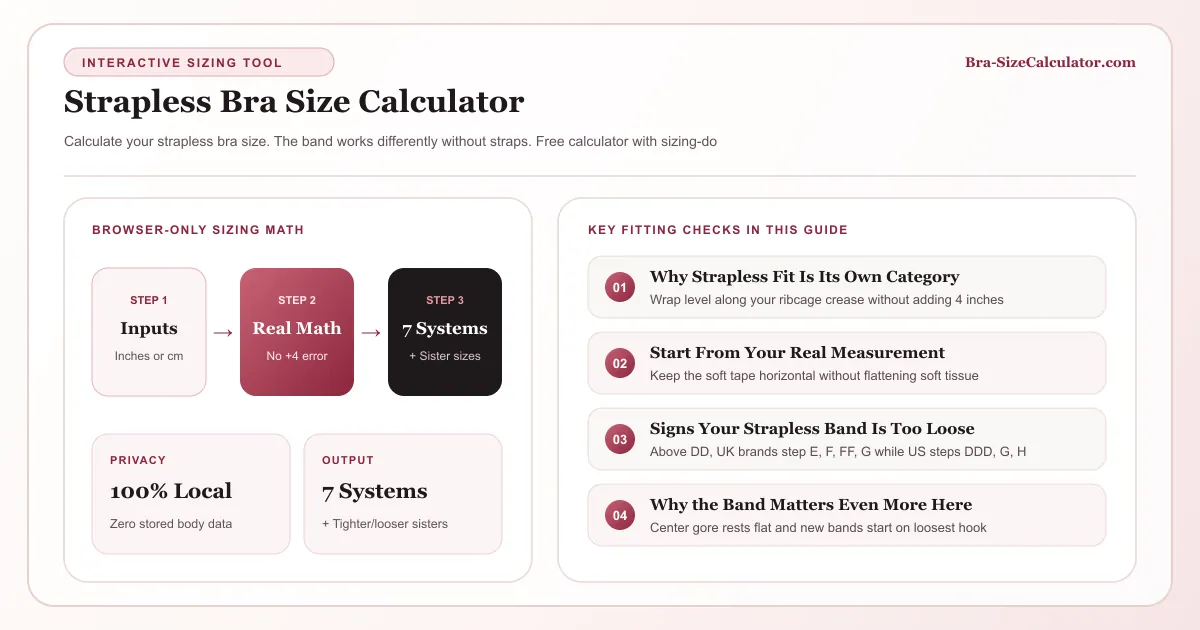
Take the straps away and the band has to do 100% of the support work alone, which is exactly why your strapless size sometimes needs to run snugger than your everyday band size.
Why Strapless Fit Is Its Own Category
In a standard bra, straps share some of the support load with the band. Remove the straps entirely, and the band alone has to keep the whole bra from sliding down, which means a band that felt perfectly snug in a regular bra can ride down within an hour in a strapless style.
Start From Your Real Measurement
Enter your underbust and bust below the same way you would for the main calculator. The band and cup math is identical. The difference isn’t in how you calculate the number, it’s in how you should interpret it: many people do better sizing down one band size specifically for strapless styles, even if their regular band size is otherwise correct.
Signs Your Strapless Band Is Too Loose
If it slips down while you’re just standing still, or you find yourself tugging it back up within the first hour, the band is too loose. No amount of internal grip silicone fixes a band that’s fundamentally too big.
Why the Band Matters Even More Here
With no straps to share the support load, a strapless bra’s band has to do basically all the work on its own. A band that’s even slightly loose (comfortable enough to overlook in a strapped bra) will let a strapless style slide down or shift within an hour. Getting the band number precisely right matters more here than for almost any other style.
A Fit Test Specific to Strapless
Once you’re wearing it, raise both arms straight overhead and hold for a few seconds. If the band stays put without you needing to tug it back into place, the size is right. If it slides down noticeably, size down in the band before assuming the whole style just doesn’t work for your body.
Why Band Fit Matters More Here Than Anywhere Else
With no straps to share the support load, the band alone has to keep the entire bra in place. A band that’s even slightly loose will show up immediately as slipping, in a way it might not with a strapped style.
How This Tool’s Math Works
This uses the same core underbust-and-bust calculation as the Main Bra Calculator. The modern method of rounding underbust up to the nearest even number for the band, then mapping the bust-to-band difference to a cup letter. The size itself doesn’t change for strapless; what changes is how much that band size actually needs to perform.
Why Some People Need to Size Down the Band Specifically for Strapless
Many people find their usual band size feels slightly looser in a strapless style than in a strapped one, purely because there’s no strap tension helping hold things in place. Trying the next band size down (with the corresponding cup-letter-up sister size) is a common, reasonable adjustment specifically for strapless styles, even when your measured size works fine everywhere else.
Construction Features That Actually Prevent Slipping
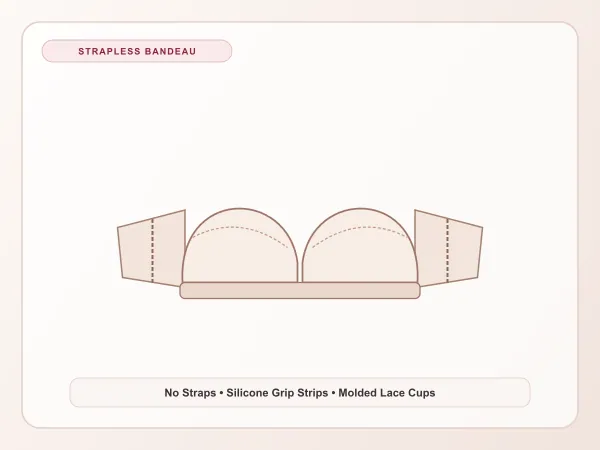
Beyond band size, look for silicone grip strips along the top and bottom edges, boning or rigid panels that prevent the band from rolling, and a band width that’s genuinely wide rather than a slim strapless-specific cut. Wider bands distribute pressure more evenly and grip more securely without needing to be uncomfortably tight.
Practicing Before the Actual Event
If you’re buying a strapless bra for a specific event, wearing it around the house for a few hours beforehand reveals any slipping issues while there’s still time to exchange it, rather than discovering a problem on the day itself.