
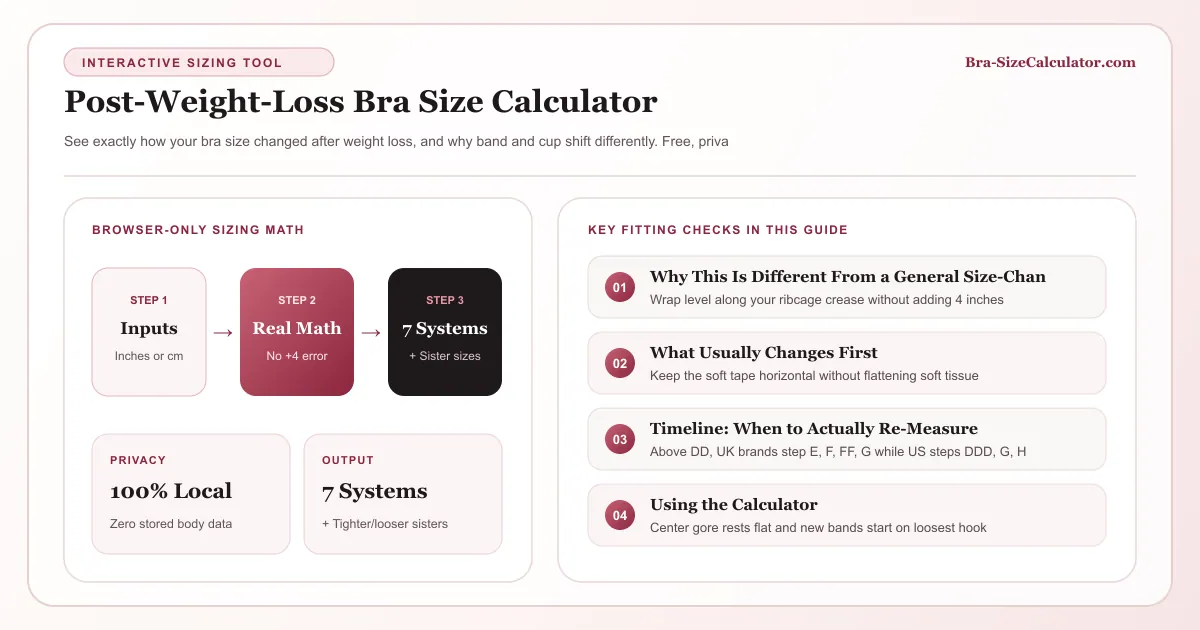
Why This Is Different From a General Size-Change Check
Weight loss affects band and cup measurements through a specific mechanism: your ribcage (band) responds fairly directly to overall body fat changes, while breast tissue composition (the ratio of fatty to glandular tissue, which is different for everyone) determines how much your cup actually shrinks, if at all. That’s why two people who lose the same amount of weight can see very different bra-size outcomes.
What Usually Changes First
Band size often shifts before cup size becomes noticeable, since ribcage circumference tends to respond to weight loss more predictably than breast tissue volume does. It’s common to end up needing a smaller band paired with a cup letter that looks the same or even larger on paper. That’s normal cup-ladder math, not a sign your body responded strangely.
Timeline: When to Actually Re-Measure
Measuring mid-loss, while your weight is still actively changing, just means you’ll need to measure again soon after. Waiting until your weight has held steady for a few weeks gives a more useful, stable result, whether the loss happened gradually or more quickly, including after weight-loss surgery.
Using the Calculator
Enter your measurements from before the weight loss and your current measurements to see exactly how your band and cup have shifted, in both directions. This is the same underlying comparison tool used across the site, framed specifically around a weight-loss timeline rather than any change over time.
Weight change, pregnancy, and hormonal shifts all move bra size in their own ways, for a more general comparison, see the Breast Size Change Calculator instead.
Band Recovers Faster Than Cup, Usually
For most people, band size (tied closely to overall ribcage and torso fat) responds to weight loss more quickly and predictably than cup volume does. Breast tissue composition varies enough between individuals that two people losing the same amount of weight can see quite different cup-size changes. Some notice a significant drop, others comparatively little, and that variation is normal rather than a sign either measurement is wrong.
Timeline Expectations
Measurements often keep shifting for weeks or months after weight has stabilized, as skin elasticity and remaining tissue continue settling into their eventual shape. Waiting until your weight has been stable for at least a few weeks before buying multiple new bras tends to save money and disappointment compared to resizing at every few pounds of change.
Why Weight Loss Affects Band and Cup Differently
Band size (your underbust measurement) tends to respond fairly directly to overall weight change, since ribcage-area tissue and fat distribution there often decreases proportionally with total body weight loss. Cup size responds less predictably. It depends heavily on how much of your breast tissue is glandular (which doesn’t shrink much with weight loss) versus fatty (which does), and that ratio is different for every individual.
What This Means for Your Expectations
Two people who lose the identical amount of weight can see very different degrees of cup change. One might drop two full cup letters while another barely changes at all, simply due to differences in tissue composition. There’s no reliable universal ratio to predict this in advance, which is exactly why re-measuring after weight loss (rather than guessing) matters so much.
How This Tool’s Calculation Works
This reuses the same before-and-after comparison logic as the general Breast Size Change Calculator, applied specifically to the weight-loss context. Enter your measurements from before and after, and it shows exactly how both band and cup shifted, independently.
Timing Your Re-Measurement
If weight loss is ongoing, re-measuring periodically (rather than once at the end) gives you a more accurate picture of your bra needs throughout the process, rather than buying new bras once and finding they’re already outdated by the time weight loss plateaus.
Budgeting for a Transitional Wardrobe
If weight loss is ongoing, it’s often more cost-effective to buy a few well-fitted transitional bras rather than a full new wardrobe at each size, since another adjustment may be needed again before the process is complete.