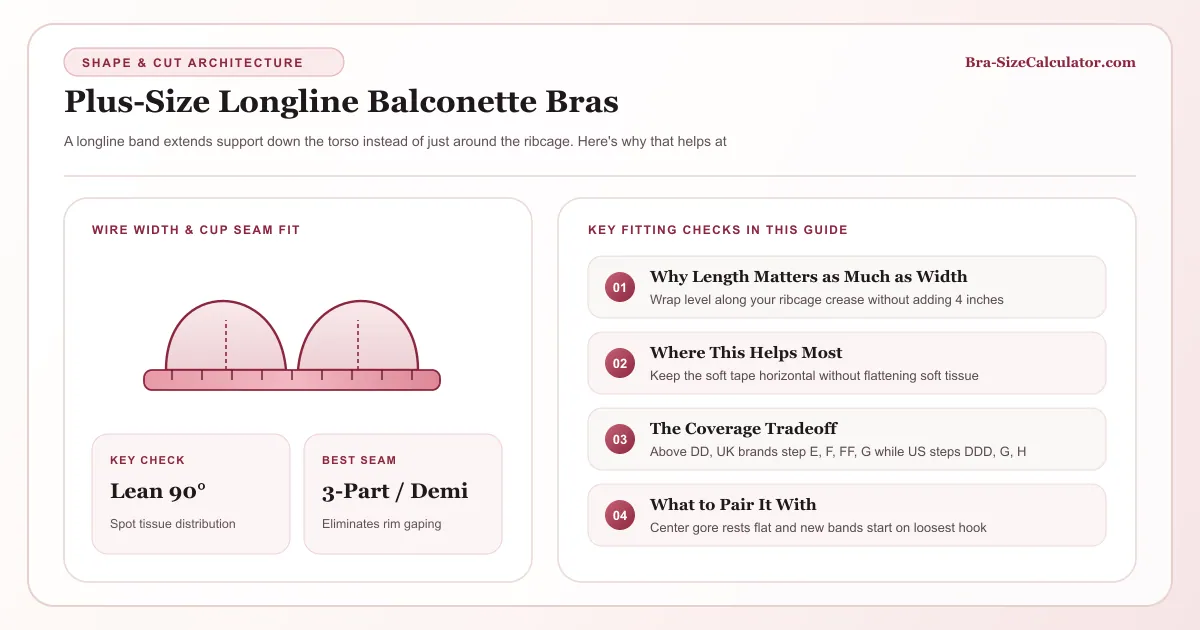
A standard bra band is a narrow ring around the ribcage, right under the bust. A longline extends that structure downward (sometimes several inches, sometimes to the waist) turning a narrow support ring into a much longer supportive panel.
Why Length Matters as Much as Width
A wider band spreads pressure around the same single height of the torso. A longline instead recruits a completely different, larger area of the body (lower ribs and upper waist) to help carry weight that a narrow band alone would concentrate in one place.
Where This Helps Most
People who find that even a wide standard band still digs in, rolls, or rides up over the course of a day often notice the difference immediately with a longline. The extra vertical coverage genuinely changes how the weight is distributed, rather than only how it feels initially.
The Coverage Tradeoff
Longline styles show more under close-fitting tops than a standard band, since there’s simply more fabric. For most people this is a non-issue under everyday clothing, but it’s worth trying one on before committing to it as an everyday style versus an occasional-wear option.
What to Pair It With
A longline band still benefits from proper strap width and placement. It solves the band-support problem specifically, not strap digging or cup shape, so it’s often combined with wider straps rather than treated as a fix for every fit issue at once.
Hook Row Count and Why It Matters More Here
A standard bra band often has two or three columns of hooks; a longline extends that same fastening system over a longer vertical span, and more rows of hooks (four, five, or six) distribute the closure’s stress over more points rather than concentrating it at just the top and bottom. Fewer hook rows on a long panel means more strain on each individual hook, which shows up as the band gradually pulling loose at the ends first.
Choosing Longline Length for Your Torso
A longer torso generally has more room to carry a deeper longline comfortably without it riding up toward the bust or bunching at the waist; a shorter torso may do better with a moderate-length longline rather than one that extends all the way to the natural waistline. Trying the actual garment on, rather than only checking cup and band size, is the only reliable way to judge this proportion.
Layering Longline Under Fitted Clothing
Because a longline extends further down the torso, it can create a visible line under thin or clingy fabric the way a standard band usually doesn’t. Choosing a longline in a smooth, line-free fabric (rather than a heavily patterned or textured one) reduces how visible that line is under fitted tops, if everyday wear under close-fitting clothing is a priority.
If a longline still rides up despite the extra vertical coverage, the band width (rather than the length) may still be the underlying issue. Length and width solve different parts of the same support problem.
Why the Extra Length Changes the Whole Fit Equation
A longline band extends support down over more of your torso, which distributes pressure across a wider area than a standard short band. This can feel noticeably more comfortable at fuller sizes precisely because the load isn’t concentrated on one narrow strip of ribcage.
Sizing Considerations Specific to Longline Construction
Because a longline band contacts more of your torso, torso length (rather than ribcage circumference) affects fit in a way it doesn’t with standard bras. A longline style can fit the band size correctly but still feel wrong if the vertical length doesn’t suit your torso proportions.
Pairing With Different Outfit Types
The extended band can show as a slightly different silhouette under very fitted tops compared to a standard-length bra. Worth trying the specific combination you plan to wear before an important occasion.
A Practical Buying Tip
If a retailer offers a fit guarantee or easy exchange specifically for longline styles, take advantage of it given how much torso-length variation affects this particular construction.