Why This Happens
Straps rely on a stable, snug band as their anchor point. If the band shifts, the straps shift with it.
Sloped shoulders can also make standard straight-set straps prone to sliding, regardless of band fit.
How to Confirm the Cause
- If tightening the band stops the slipping, the band was the anchor issue.
- If straps still slide off a snug band, your shoulder slope may need a racerback or convertible strap style.
- Straps that are simply too loose (adjusted too long) will slip regardless of band fit.
The Fix
First tighten the band and shorten the straps to the correct length. Straps should lie flat without digging in.
If slipping continues, a racerback strap configuration (or a convertible strap set to racerback) holds much better on sloped shoulders than a traditional straight strap.
When It Might Be Something Else
Straps that slip only on one side often point to shoulder asymmetry, which a strap clip (holding both straps together at the back) can address without buying a new style.
The 30-Second Self-Check
Do your normal daily movements (reach, turn, sit down) and count how many times a strap slides off your shoulder within a few minutes. If it happens repeatedly without you touching it, the strap angle or band fit is the cause, not your shoulders being “too sloped.”
Two Different Root Causes, Two Different Fixes
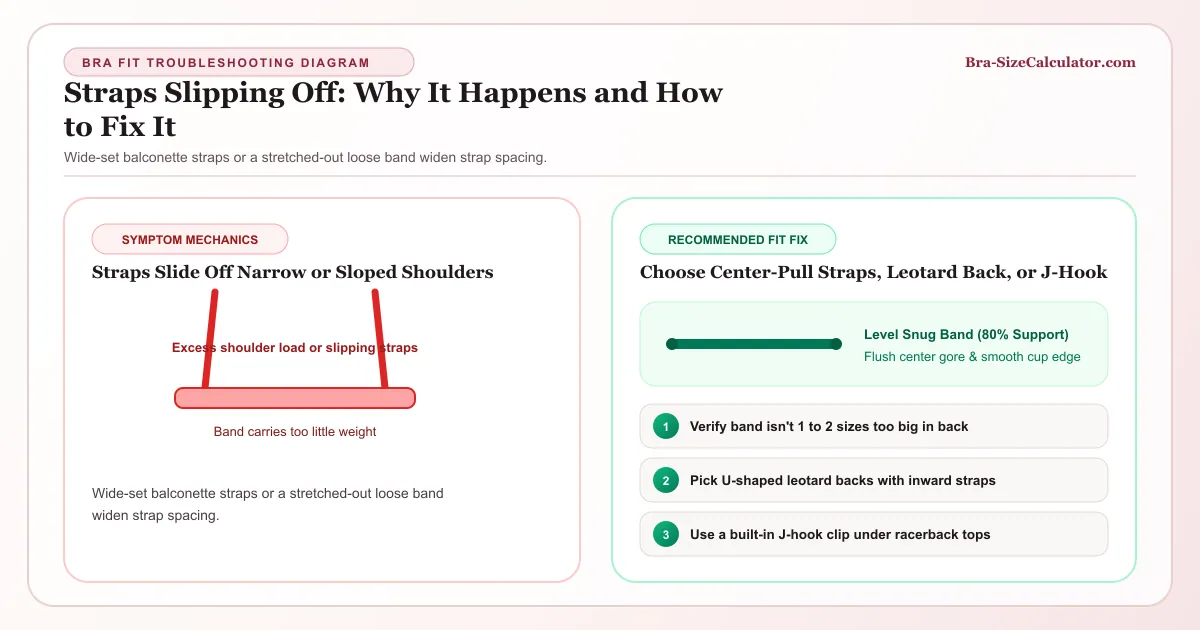
Straps set too far apart for narrow or sloped shoulders will slide no matter how tight you make them. The fix is a racerback style or a strap-converter clip that changes the angle, not a smaller size. Straps that slide because the whole band is loose need a band-size fix instead, since a properly snug band keeps the entire bra anchored in place.
Tightening slipping straps as far as they go without addressing the underlying cause usually just trades slipping for shoulder pain.
Slipping Isn’t Always About Strap Adjustment
Sloped shoulders (a genuine, common shoulder shape, not a flaw) can cause straps to slide regardless of how tight they’re adjusted, simply because there’s less of an angle to hold them in place. A racerback, convertible, or crisscross strap configuration works with this shoulder shape instead of fighting it.
When Strap Width Is the Real Issue
Thin straps have less surface area to grip skin and fabric, making them more prone to sliding even on a well-fitted band. Switching to a wider-strap style in the same size sometimes solves persistent slipping that adjusting a thin strap never fully fixes.
A Quick Self-Check
Check your shoulder slope in a mirror. More sloped shoulders naturally give straps less to grip, so straps that are perfectly adjusted can still slide on a more sloped shoulder line even in an otherwise well-fitted bra.
How to Tell This Apart From Similar Problems
This overlaps with band-rides-up since a loose band is a common root cause of both problems, but slipping straps can also happen with a perfectly snug band if the strap angle simply doesn’t match your shoulder slope. Tightening the band won’t fix a pure strap-angle mismatch.
What to Try First
Try adjusting strap length fully first, then a racerback or crisscross conversion clip before assuming you need an entirely different bra. These clips are inexpensive and easy to test.
A Realistic Example
This is especially common in people with a narrower shoulder-to-shoulder measurement relative to their band size. Standard strap spacing assumes an average shoulder width, and a genuinely narrower frame needs either adjustable convertible straps or a style specifically cut for narrower shoulders.