Why This Happens
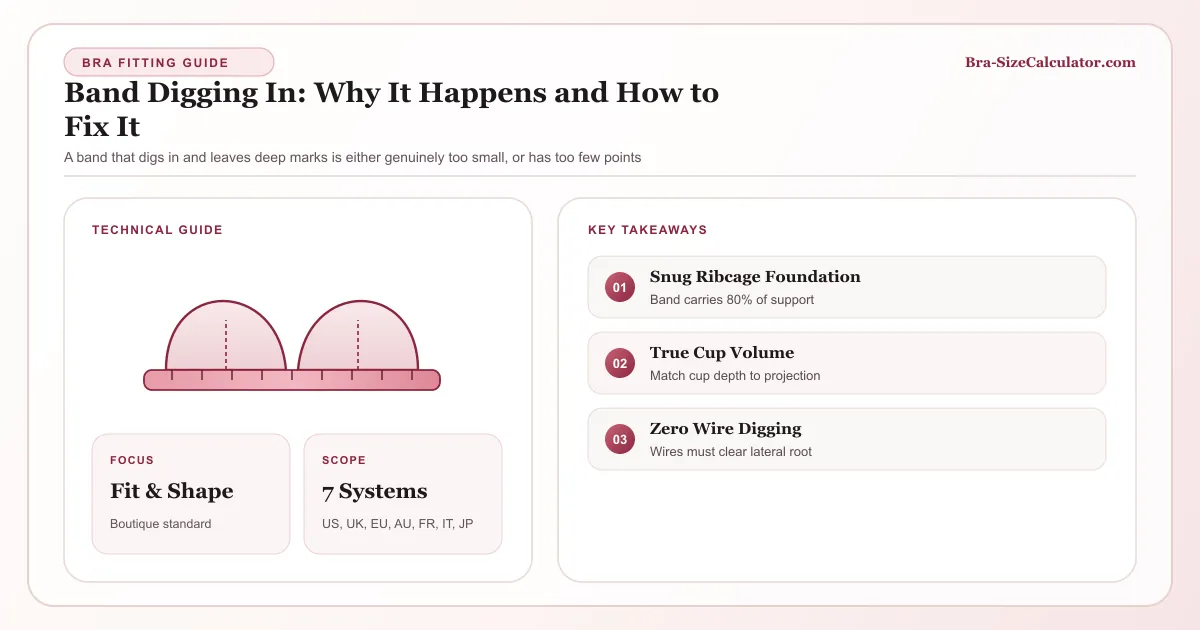
Digging in is different from simple snugness. Snug is even pressure with no marks; digging in means concentrated pressure, usually because the band is stretched to its tightest hook with no room left to adjust.
It can also happen with narrow bands that concentrate the same tension into a smaller surface area.
How to Confirm It
- You’re on the tightest hook already, with no looser setting to try.
- Marks last well beyond a few minutes after removing the bra.
- A wider-banded style in the same size feels noticeably more comfortable.
The Fix
Go up a band size and down a cup size to land on a sister size with the same volume but more room in the band.
Choosing a style with a wider band or more back panels spreads the same amount of tension over more surface area, which alone can meaningfully reduce digging.
When It Might Be Something Else
If digging happens only after several hours, some loosening throughout the day is completely normal. But if it’s present within the first hour of wearing, the size is the more likely cause.
The 30-Second Self-Check
Take the bra off after a few hours of wear and look at your ribcage. A faint, brief line that fades within a couple of minutes is normal. A deep groove, redness that lasts, or visible indentation is your band telling you it’s too tight for its width.
Digging In Isn’t Always About Band Size
Sometimes the band size is right but the band itself is too narrow for comfortable pressure distribution. Wider-band styles spread the same support across more skin and can eliminate digging-in at the exact same size. Other times the band genuinely is too small and needs to go up while the cup comes down to compensate (a sister size).
Digging in that appears only at the very end of a long day, but not earlier, often points to a band that’s borderline rather than clearly wrong. Worth testing a sister size before assuming a full resize.
A Quick Comparison Worth Trying
If you own a bra in the same size from two different brands, compare how each band feels after an hour. A noticeable difference points to construction (band width, elastic quality, panel count) rather than the size number itself being wrong.
Materials Make a Real Difference Here
Bands made from a single layer of stretch fabric concentrate tension differently than bands built with multiple bonded layers or power mesh. The latter tend to distribute pressure more evenly even at an identical measured size, which can be the difference between comfortable and digging.
A Quick Self-Check
Check exactly where the digging occurs. If it’s concentrated right at the closure/hook area specifically rather than evenly around your whole ribcage, that points to construction (a stiff closure panel or seam) rather than overall band size being wrong.
How to Tell This Apart From Similar Problems
This is distinct from band-too-tight, which describes overall excessive compression. Band-digging-in can happen even in a correctly-sized band if the specific construction (a narrow closure panel, a seam positioned right over a sensitive spot) creates a localized pressure point that a differently-constructed band in the same size wouldn’t cause.
What to Try First
Try the same size in a different brand or style with a wider or softer closure panel before sizing up. The digging may be about construction at that specific spot, not overall band size.
A Realistic Example
Someone who recently switched to a budget or older bra from a favorite worn-out one sometimes notices new digging even at the identical size. Cheaper closure construction or a worn-out favorite’s already-broken-in hardware can both explain the difference, independent of the size number.