Free, private, no signup: this page (and every calculator on this site) runs entirely in your browser. Nothing you enter is stored.
How China Sizing Actually Works
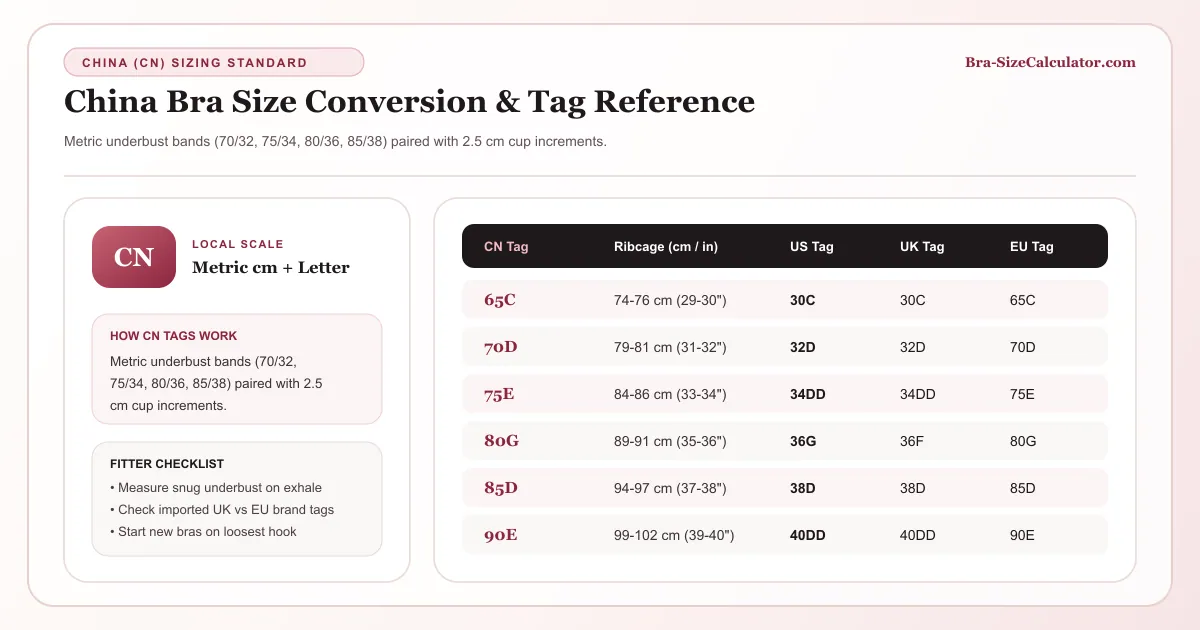
Chinese band sizing has traditionally leaned toward a raw-underbust cm approach similar to Japan and Korea, though larger international chains increasingly use EU-style labeling.
Because of this mix, check whether a specific product page or tag references a domestic Chinese chart or an EU-style one before trusting a straight conversion.
Convert Your Size
Use the calculator above to see your size across all 7 systems this site supports, China included. If you already know your size in another system, enter it into the Global Bra Size Converter instead of doing the math by hand.
Getting an Accurate Starting Point
A conversion is only as good as the numbers going into itHow to Measure walks through the exact method used here, and the Sister Size Calculator can help if the result doesn’t feel like a perfect match.
A Worked Example: Shopping in China
Say your measurements convert to a US 40DD. If you’re buying an American brand, ask for exactly that.
If the label is European, convert to roughly 120cm band, E cup using the Global Size Converter. If it’s an Asian import, expect a band closer to 100cm with a similar cup letter. The tag’s country of manufacture is your best clue for which conversion applies.
Shopping Locally vs. Importing in China
Major Chinese e-commerce platforms often list sizes using a local numeric code that doesn’t map directly to band/cup sizing at all. Check for a supplementary cm chart on the same listing before ordering.
Common Sizing Mistakes Shoppers Make in China
A common mistake on Chinese platforms is trusting the platform’s own generic size label (S/M/L) instead of looking for the specific cm chart, which is usually buried further down the listing.
Another mistake on Chinese platforms is trusting a seller’s photo-based size comparison chart over an actual tape-measure conversion, since these charts are often approximate at best.
A Note on Retail Fitting in China
Larger Chinese department stores in major cities increasingly offer in-person fitting, though most online-only platforms rely entirely on self-reported measurements.
Handling Sizing When Shopping Chinese Retailers
Chinese sizing isn’t part of this site’s core seven-system conversion table, and cross-platform marketplaces in particular can have inconsistent sizing between individual sellers. Checking a specific listing’s own chart matters more here than in more standardized markets.
How Metric and International Brands Mix in China
China’s retail market includes both large established brands and enormous numbers of independent sellers, particularly on major e-commerce platforms. This fragmentation is exactly why a single unified expectation for sizing doesn’t really exist here.
Cross-Border E-Commerce Adds Another Layer
Many Chinese online sellers ship internationally and often list sizes based on the buyer’s expected home market rather than a domestic Chinese standard, which can create confusion if you assume a fixed “Chinese size” convention exists.
Major Shopping Festivals Affect Availability and Pricing
Large annual shopping events on major Chinese e-commerce platforms often feature significant lingerie promotions. Timing orders around these periods can affect both price and the range of sizes actively in stock.