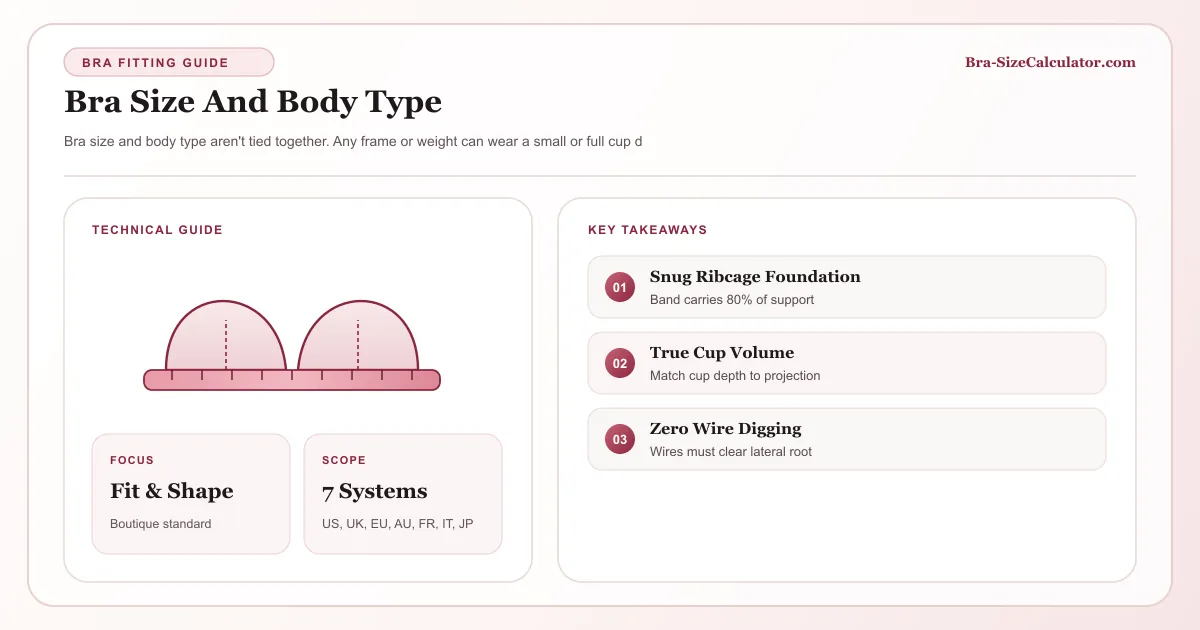
Bra size and overall body type aren’t strictly linked. People of every body type and every weight can have any band and cup combination, since breast size depends on individual tissue composition, rather than only overall frame.
Free, private, no signup: every calculator and guide on this site runs in your browser. Nothing is stored.
Why Body Type Doesn’t Predict Bra Size
It’s a common assumption that a smaller frame means a smaller cup, or that a larger frame means a larger cup, but breast tissue composition varies independently of overall body size. A petite frame can have a large cup size, and a larger frame can have a small one. Both are completely normal.
Band Size Relates to Frame, Cup Size Doesn’t Always
Your band size (ribcage measurement) is more closely tied to your overall frame than your cup size is, which is exactly why the two numbers are measured separately, and why sister sizing (see our Sister Size Calculator) exists to separate band fit from cup volume.
The Only Reliable Way to Know
Skip assumptions based on body type and measure directly with the Main Bra Calculator- it’s the only way to know your actual size regardless of your frame.
The “Frame Size” Myth in Sizing Charts
Some casual sizing guides imply that petite frames pair with small cups and larger frames pair with large cups. Real bodies don’t sort that neatly. Band size (frame) and cup size (tissue volume) are measured independently for exactly this reason.
What Actually Correlates, and What Doesn’t
Overall body weight has some loose relationship with breast size on average across a population, but it’s weak and full of exceptions at the individual level. Height, general build, and muscle tone have almost no reliable relationship with cup size at all.
If a size chart or salesperson has ever implied your frame ‘should’ pair with a certain cup, that guidance was based on a myth, not the actual anatomy of how band and cup are measured.
Why There’s No Single “Matching” Body Type
Bra size describes local chest measurements (band and cup) not overall body proportions, and any given bra size shows up across every body type, height, and weight. A 34C and a 44C can both belong to people of a similar overall build, or to people who look nothing alike; the letter doesn’t predict the rest of the body.
Where Body Type Does Matter
Overall frame affects which bra styles feel most comfortable and supportive, even at the same size. A narrower frame might prefer a shorter wire and closer-set straps, while a broader frame might do better with wider-set straps and a longer wire, independent of the size number itself.
The Only Real Rule
Your actual band and cup measurement, not an assumption based on height, weight, or general build, is the only reliable way to find your size. Bodies don’t sort neatly by type, and treating bra size as a body-type indicator leads to more guessing than measuring ever would.
Body Type Isn’t Destiny
General body-type categories (pear, hourglass, rectangle, and similar) describe overall proportion tendencies, not a fixed rule about what bra size someone “should” be. Two people with the same general body type classification can have completely different bra sizes, since bust volume and overall body shape are related but genuinely separate characteristics.
Why Two People With the Same Body Type Can Wear Different Sizes
Body type descriptions are based on the relationship between bust, waist, and hip measurements. They don’t capture the actual volume of breast tissue itself, which varies independently. This is exactly why body type alone is a poor predictor of bra size, even though the two concepts get discussed together often.
The Only Chart That Matters Is Your Own Measurement
Skip trying to reason from body type to bra size altogether. Going straight to an actual band-and-bust measurement is faster and more reliable than any body-type-based inference could be.
Measurement Over Assumption, Always
Whatever body type language you’ve encountered elsewhere, treating your actual band-and-bust measurement as the authority (rather than any body-type-based guess) will consistently serve you better.