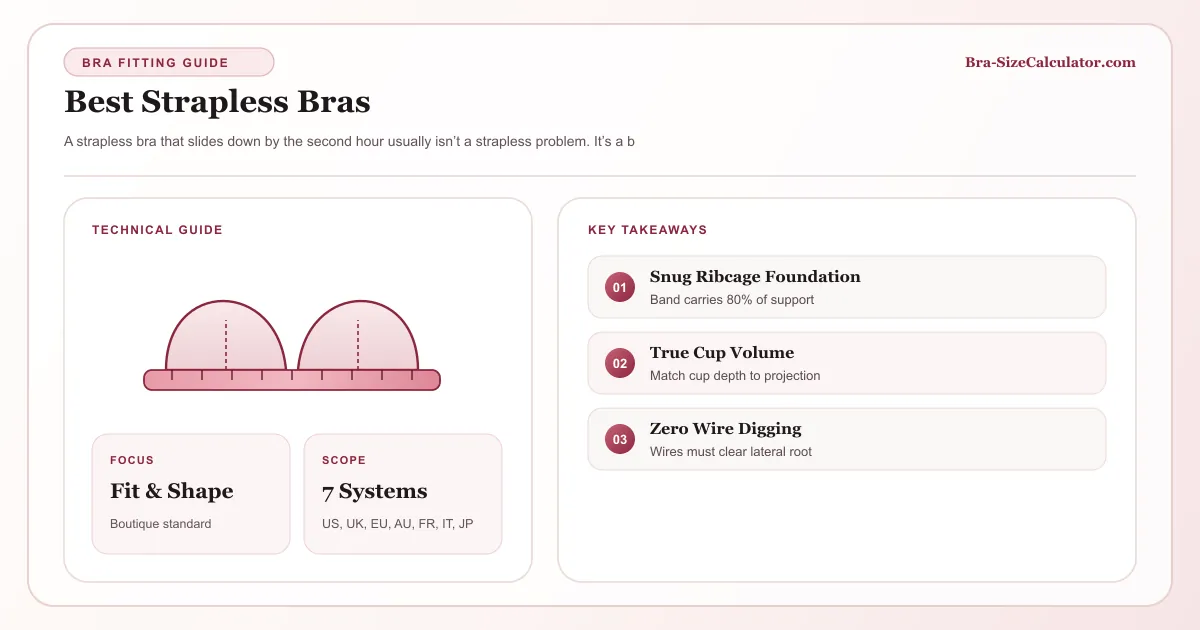
A strapless bra that slides down by the second hour usually isn’t a strapless problem. It’s a band problem. Without straps to share the load, the band has to do 100% of the work on its own.
Every calculator on this site is free, runs in your browser, and stores nothing. The same is true here. Getting your real size right fixes most of what a “best bras for X” list is really trying to solve.
What to Actually Look For
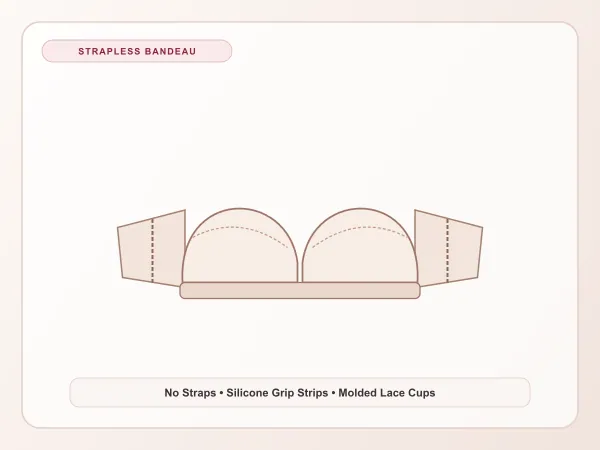
- Silicone-lined band interior: A thin grip strip along the inside of the band keeps it from creeping down against skin.
- Boning or rigid side panels: Light structure along the sides holds shape where straps normally would help.
- A genuinely snug band: This is the one style where the band should feel noticeably firmer than your everyday bras. It has no backup.
Get the Sizing Right First
Because straps aren’t there to help, go down a band size from your usual fit if your normal band already feels loose without straps engaged. Confirm the starting point with the Main Bra Calculator first.
The Most Common Mistake
Choosing a strapless bra by cup size alone and ignoring band snugness. Cup size doesn’t matter if the whole bra is sliding to your waist.
- Claire Bennett, 10+ years fitting women in-store before writing a single page here.
Why Strapless Bras Slip (It’s Not Bad Luck)
Without straps to help hold position, the band alone has to do 100% of the support work, which means a strapless bra needs a snugger band than your usual size, not the same one. If your regular band feels correct in a normal bra, it will likely feel loose the moment you remove the straps.
Adding Grip Without Sacrificing Comfort
Silicone strips along the top band edge and a slightly firmer, wider band both help a strapless style stay put through movement. Avoid sizing up the band “for comfort” here specifically. A looser band is the single most common reason strapless bras slide down.
The Physics of Staying Up
Without straps to share the load, the band alone must create enough friction and snugness to stay in place against gravity and movement. This is why band fit matters more here than in any other category. Even a slightly loose band that would be tolerable in a strapped style becomes a real slipping problem strapless.
Band Grip vs. Comfort Tradeoffs
Silicone-lined bands grip skin more effectively than plain fabric but can feel warmer and occasionally irritate sensitive skin over long wear. Wider bands distribute the necessary grip over more surface area, often striking a better comfort-to-hold balance than narrow bands relying on tightness alone.
Why the Band Has to Do All the Work
With no straps to share the support load, a strapless bra’s band alone has to keep the entire garment in place through movement, which is why band accuracy matters more here than in any other bra style. A band that’s even slightly loose will show up immediately as slipping in a way it might not with a strapped alternative.
Silicone Grip and Boning, Explained
Many strapless designs add an internal silicone strip along the top and bottom band edges to reduce slipping through friction, and some add light boning (flexible support strips) at the sides to prevent the band from folding or rolling. These are construction features layered on top of correct sizing. They help, but they don’t substitute for the right band size to begin with.
Testing Grip Before a Full Day of Wear
Raising both arms and moving around in the fitting room (or right after trying it on at home) reveals slipping issues faster than standing still ever will. Test movement before committing to a strapless style for an event.
Testing a Strapless Bra Properly Before Buying
Raise both arms overhead and move around in the fitting room before deciding. A strapless bra that looks secure standing still can slip immediately once you actually move, which standing still never reveals.
A Silicone Grip Strip Isn’t a Substitute for Band Fit
Grip strips help reduce slipping at the margins, but they can’t compensate for a band that’s fundamentally too loose. Get the band size right first, then let grip features handle the fine-tuning.