Asymmetry Is Normal, Not Rare
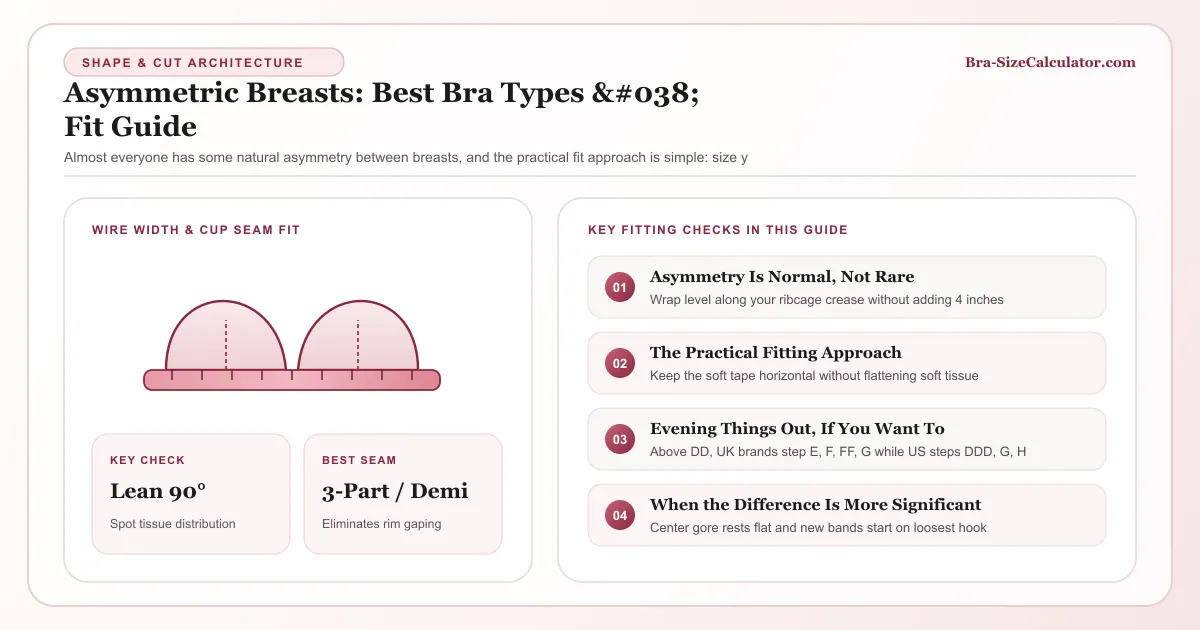
Most people have some degree of size or shape difference between their two breasts. It’s genuinely one of the most common, least-discussed facts in bra fitting. A noticeable difference is not a flaw or something unusual; it’s simply how bodies typically develop, and it doesn’t need to be treated as a problem to solve.
The Practical Fitting Approach
Size to your larger side. It’s far more comfortable to slightly under-fill a cup on your smaller side than to force your larger side into a cup that’s genuinely too small. An overfull cup causes real fit problems (spillage, discomfort, visible lines), while a slightly roomy cup on the other side is a minor, easily-solved cosmetic issue.
Evening Things Out, If You Want To
A style with removable padding lets you add a thin pad to only the smaller side, filling the extra room without affecting the larger side’s fit at all. Lightly padded or push-up styles built with symmetrical padding can also visually balance a moderate difference.
None of this is required. Plenty of people wear asymmetric fit exactly as-is with no padding adjustments and that’s equally valid.
When the Difference Is More Significant
For a larger, more pronounced asymmetry, some people find dedicated bras designed for asymmetric fit (with independently adjustable cup volume on each side) more comfortable than standard padding tricks. This is a personal comfort choice, not a requirement, and there’s no “correct” degree of asymmetry that requires a special solution.
How Common Asymmetry Is
Some degree of size or shape difference between the two sides is extremely common. Most people have noticeable asymmetry once they look closely, and it’s a normal variation rather than something unusual.
Fitting Strategy That Works
Fit to your larger side, and use a removable-pad style to add volume to the smaller cup if you want a more even outward appearance. Soft, flexible molded cups adapt better to two different volumes than rigid preformed shapes, which force both sides into an identical mold.
How Common This Actually Is
Some degree of size difference between sides is genuinely common. Most people have at least a small natural asymmetry, and it becomes a practical fitting consideration mainly when the difference is large enough to affect how a standard bra sits on one side versus the other.
The Sizing Approach That Works Best
Sizing to the larger side and using a thin removable pad or insert on the smaller side is the most reliable approach. Trying to find one size that averages between two genuinely different sides tends to leave both sides less well-fitted than picking one reference point and adjusting.
A Reminder About What’s Actually Normal
Nearly everyone has some degree of size difference between sides. This guide exists to help with practical fit, not because asymmetry itself is unusual or needs explaining as a problem.
One Last Practical Reminder
If sizing to your larger side ever feels genuinely uncomfortable on the smaller side, adjusting the padding amount (rather than switching your base size again) is usually the simpler fix.